

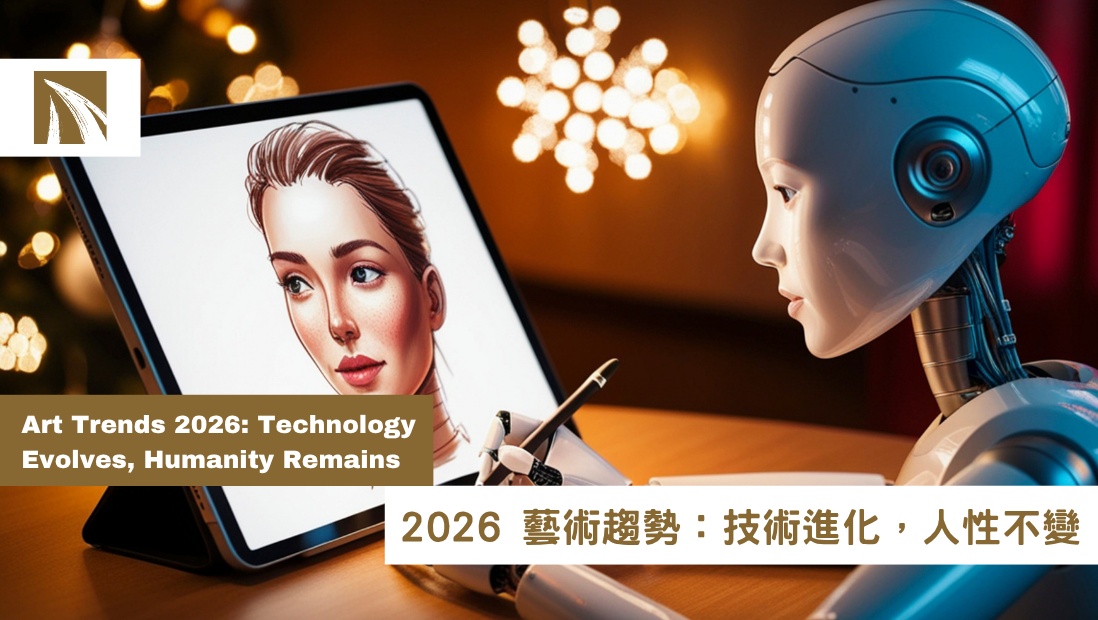
As we look back from 2026, the art world no longer resembles what people imagined a decade ago. Generative AI has moved from laboratories into studios, immersive experiences have spread from theme parks to museums, and blockchain has settled from speculative frenzy into a practical asset management tool. Yet beneath these dramatic changes, one core proposition remains unchanged: the essence of art still lies in humanity.
Generative AI as a Creative Partner, Not a Replacement. By 2026, the vast majority of visual artists, designers, and multimedia creators have integrated generative AI into their daily workflows. Unlike early anxieties about “AI replacing artists,” the current consensus is that AI excels at generating variations and combinations, but cannot replace human emotional judgment and lived experience. Artists use large multimodal models for rapid ideation, style transfer, and detail generation, then filter and reconstruct the results with their own aesthetic sensitivity. This “human-AI collaboration” model actually reinforces the human element of originality — the intuition, memory, and social concern that algorithms cannot fully replicate.
Immersive and Mixed Reality: Space Is No Longer a Constraint. By 2026, audiences no longer need to travel to specific cities to see world-class exhibitions. Lightweight mixed-reality (MR) glasses and high-speed mobile networks allow virtual galleries to appear anywhere — in living rooms, cafés, or parks. Meanwhile, physical exhibitions have moved toward “hyper-sensory” experiences, combining projection mapping, 3D soundscapes, vibrating floors, and scent dispensers to create fully immersive narrative environments. Notably, technological advances have not weakened human connection; many exhibitions specifically design multi-user synchronous viewing modes, allowing distant friends to “walk into” the same artwork together and share their impressions in real time.
Blockchain and Digital Ownership: A Return to Pragmatism. After the NFT craze and crash between 2021 and 2024, blockchain applications in the art world have completely shed their speculative image by 2026. Next-generation low-energy blockchains and decentralized identity technologies allow artwork provenance to be permanently preserved at very low cost. Today, over 80% of primary-market galleries issue tamper-proof “digital passports” for each physical artwork, recording the complete history from creation, exhibition, transport, and every transaction. Smart contracts automatically distribute royalties to creators and their heirs, solving the long-standing resale-right issue that has troubled artists. Technology has finally returned to its original promise: building trust, not creating bubbles.
The art world in 2026 has demonstrated an extraordinary density of technology and social awareness. Yet whether it is AI collaboration, immersive spaces, or sustainable materials, everything ultimately returns to the fundamental human need for meaning, emotion, and connection. For art industry professionals and collectors, understanding these trends is not about chasing fashions, but about maintaining sound judgment amid change and supporting creations that possess true originality and a sense of responsibility. In this era of constant evolution in the art industry, Milestone does not chase fleeting trends. Instead, we focus on becoming the most trusted bridge between creators, collectors, and institutions, providing professional art services. Whether it is art transportation, packing, storage, or installation, our professional team approaches every task with rigorous dedication. We stand by the principle: respond to creativity with professionalism, and safeguard value with responsibility.